
Point of use
Under-Sink Drinking Water Filters in Carmel, IN, Fitted Where You Fill the Glass
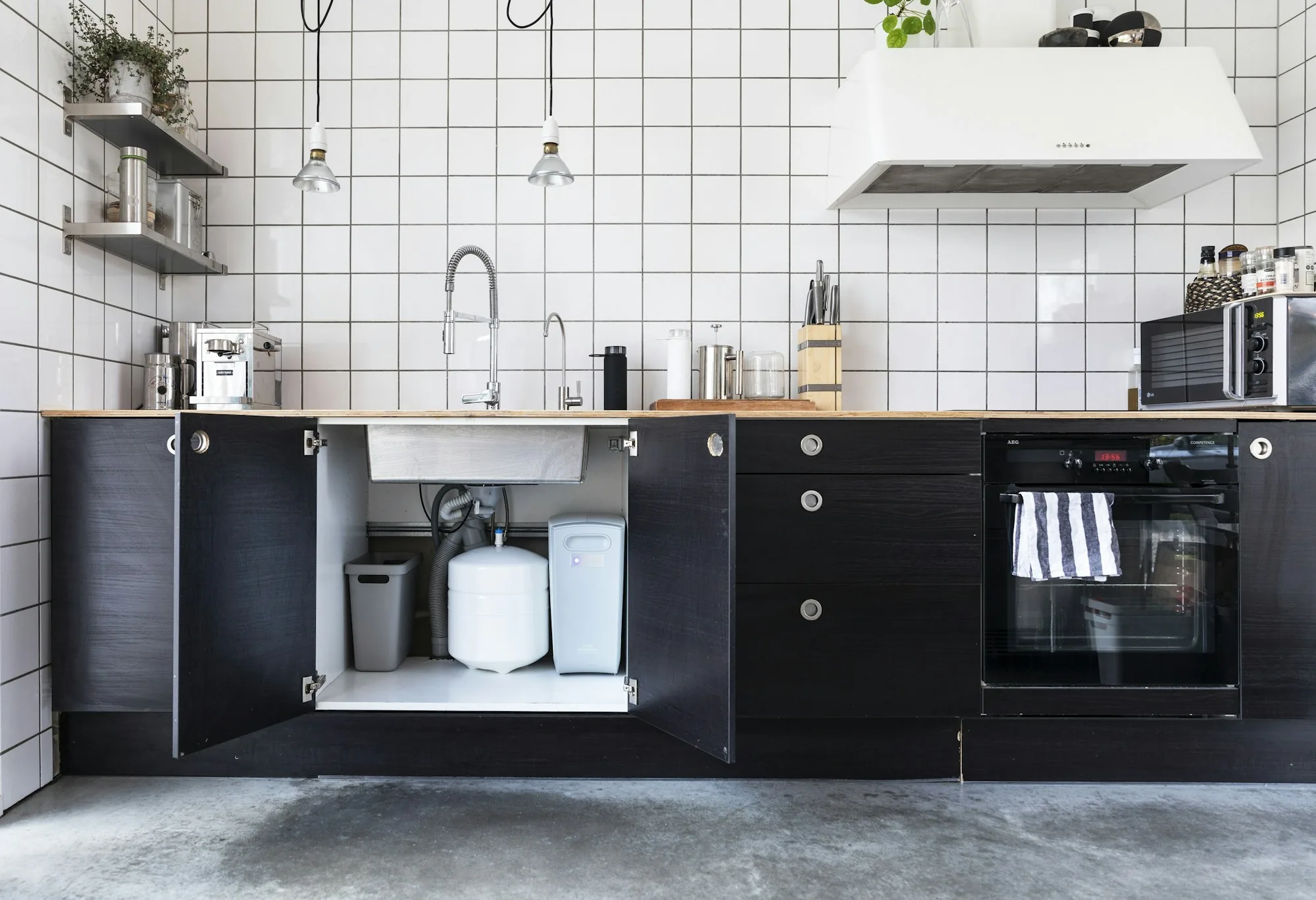
A guest fills a glass at your kitchen tap, pauses at the first sip, and politely says nothing. Point-of-use filtration solves exactly that, in the cabinet below the sink, and homes around the Arts & Design District where cabinet space is tight tend to be the ones that benefit most from how little room it takes.
Why point of use
Under-sink filtration for Carmel kitchens, without the plumbing of a larger system
Treating one tap properly is a reasonable goal, and for a great many households it is the whole job. A cartridge system intercepts the cold line feeding your kitchen faucet, which is where nearly all the drinking and cooking water in a house actually gets drawn, and leaves the rest of the plumbing untouched.
The trade is worth understanding before you buy. These units will not soften the hard, limestone-fed water heading for your water heater, and they do not reach the dissolved mineral that a membrane separates out, but they run at the full speed of your tap, hold no stored water, and send nothing down the drain. For chlorine taste, odor, sediment and the particulate concerns that bring most Hamilton County homeowners to the phone, a well-chosen cartridge is both the simplest answer and the least intrusive one.
Covered in an under-sink fitting
Small systems reward careful work. Every item below is part of a standard fitting rather than an upsell.
- Cartridge selected against your water Carbon block, sediment and specialty cartridges each target different things, so we read your water before picking. A cartridge chosen for taste will not help someone whose real complaint is grit.
- Cold supply isolated cleanly The tie-in goes on the cold feed to the kitchen faucet with its own shut-off valve. That valve means a cartridge change later never involves crawling for the main.
- Housings mounted, not left loose Filter bodies are fixed to the cabinet wall rather than left resting on the base where a bin or a bottle of cleaner will knock them. Loose housings are how fittings work themselves slack.
- Clearance left for cartridge swaps We leave enough room below each housing to drop the sump without emptying the cupboard first. A system you cannot service is a system that stops getting serviced.
- Dedicated faucet or existing tap You can take filtered water through a separate deck faucet or straight through the mixer you already have, and we talk that choice through before any hole is drilled.
- Sediment stage where grit demands it Houses on private wells out past Sheridan and Lebanon often need a particulate stage ahead of the carbon, otherwise the finer cartridge blinds off in weeks instead of months.
- Flow checked at the tap After fitting we run the faucet and confirm you have not lost noticeable pressure. A point-of-use system should feel like the tap always did.
- Fittings pressure-tested before closing up Every connection is run under pressure and dried off, then checked again before the cabinet door closes. Leaks under a sink go unnoticed for a long time and ruin cabinet bases.
- Change interval set to your household Cartridge life depends on how much water the kitchen moves, not on the number printed on the box. We give you a realistic interval for your household and what a tired cartridge tastes like.
What to expect
Three short steps, one afternoon
Point-of-use work is quick, which is no reason to do it carelessly.
A look under the sink and a reading
We measure chlorine, sediment and hardness at your kitchen tap and then open the cabinet to see what we are working with. Disposals, pull-out bins and reverse-osmosis leftovers from a previous owner all change the layout. You will hear straight away whether a cartridge system is the right fit or whether your complaint really needs something at the point of entry. Expect half an hour.
Cartridge choice and a flat figure
The reading points to the cartridge train, whether that is a single carbon block or a sediment stage followed by carbon. We quote the housings, the fitting, the faucet if you want one, and the first set of cartridges as a single flat price. If an existing system under there can be revived with new cartridges and a new head, we will say so plainly. The choice stays yours.
Fitting and handover
The cold feed is isolated, the shut-off and housings go in, and the lines are run so they are not fighting the bin or the disposal. We flush the carbon through until the water runs clear of fines, then check flow and pressure-test every joint. The handover covers the shut-off, the sump wrench and the change interval. Most fittings take an afternoon at most.
What sets it apart
Why Carmel Water Filtration for point-of-use work
Small jobs tell you more about an outfit than large ones do.
We will tell you when it is not enough
If your real problem is scale on the fixtures or iron staining in the tubs, a cartridge at the sink will not fix it and we would rather say so at the reading. Honest scope beats a sale that disappoints in a month.
Built to be serviced
Clearance, a dedicated shut-off and mounted housings are what separate a cartridge change you can do yourself from one that needs a visit. We fit for the second year, not just the first.
Nothing wasted, nothing stored
No drain line and no storage tank means no reject water and no tank taste, which suits households that simply want the kitchen tap to taste right. It also means a far smaller footprint in a crowded cabinet.
- Scope stated honestly If the problem belongs at the point of entry, we say so before quoting a cartridge.
- A single flat figure Housings, fitting and the first cartridge set are priced as one figure up front.
- Serviceable by you Shut-off valve, clearance and a sump wrench are left so a change is a ten-minute job.
- Service stays with us When you would rather not do it yourself, the same team handles the cartridge change.
A small job, done properly
Better water at the tap you use most
Most households drink and cook from one faucet, and treating that one well is often the whole answer. Tell us what the water tastes like and we will read it, fit the right cartridge train, and leave you able to service it. The number here is (317) 622-4157.
Kitchens served in Carmel, Westfield, Zionsville, Fishers and Noblesville.